
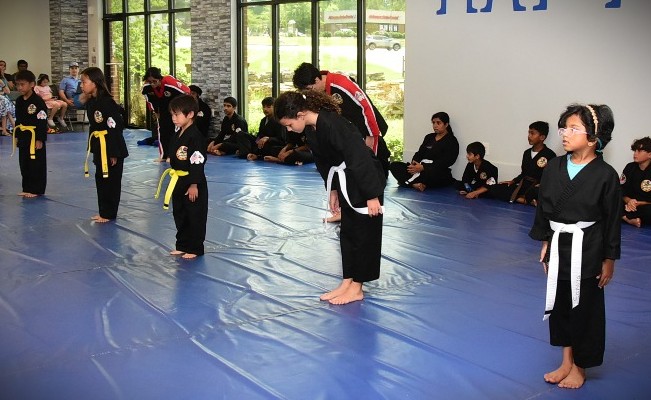
What does focus training for children look like in a martial arts school? Let’s take a closer look at how structured training supports attention, listening, and steady cognitive growth.
“Shoes away, please.”
“Sit still.”
“Did you start your homework?”
“Please don’t interrupt — I’m still talking.”
If this sounds familiar, just know you’re not alone. When kids start martial arts, one of the first conversations we often have with parents is about focus — and how structured training can help strengthen it.
Children are still developing executive function skills like impulse control, sustained attention, and the ability to follow multi-step directions. With consistent practice, these skills can grow in the right direction and help kids succeed in school, at home, and beyond. What we’ve seen over decades of teaching is that martial arts provides a structured environment where children can work on these areas in a way that feels engaging and productive.
Many parents look for practical ways to improve attention and listening skills. Research shows that focus training for children is most effective when it includes clear routines, step-by-step instruction, physical movement, and consistent expectations. These strategies are often recommended in parenting and educational settings — and they are naturally built into structured martial arts programs.
At Choe’s HapKiDo Martial Arts, focus is practiced intentionally through repetition, guided instruction, and clear accountability — helping students strengthen listening and direction-following skills in a steady, supportive way. Over time, those weeks of consistent training begin to add up. Progress that once felt small becomes noticeable, and the years of steady development move faster than most families expect.
Structured Environment and Routine
Experts often recommend creating a designated, distraction-free space and maintaining consistent routines to support attention. Martial arts classes are intentionally structured in this way.
Students line up in the same formation each class. They bow in, review expectations, and follow a predictable sequence of drills and instruction. Clear boundaries on the mat help define personal space and reduce chaos. This consistency lowers uncertainty and allows children to focus on the task at hand rather than navigating unpredictable transitions.
Over time, this repeated structure strengthens attention and reduces impulsive behavior.
Breaking Skills into Manageable Steps
Another widely recommended strategy for improving focus is breaking tasks into smaller, manageable parts. Multi-step instructions can overwhelm children, especially when attention is still developing.
In martial arts training, techniques are taught step by step. Students begin with foundational movements and gradually build on them over time. The super cool flying sidekicks and jumping snap kicks come later — after balance, control, and proper form are established.
Instructors demonstrate a technique, students practice a simpler version, and then layers are added as skills improve. With consistent guidance and repetition, progress becomes steady. Belt progression reinforces this approach. Students must demonstrate understanding of foundational skills before advancing to the next level.
This method supports focus training for children by helping them process information in sequence rather than all at once. Listening becomes purposeful because each step builds on the previous one. Instead of rushing ahead, students learn to slow down, follow the order of instruction, and trust the process.
Movement as a Tool for Attention
Research consistently shows that physical activity improves cognitive function and reduces impulsivity. For many children, movement greatly improves focus.
Martial arts channels energy into structured drills that require both physical engagement and mental awareness. Students move with intention, pause before executing techniques, and respond only when given a cue. Instead of suppressing energy, training teaches children how to direct it appropriately.
This balance between movement and control helps strengthen attention skills in a way that feels natural and sustainable.
Active Listening and Immediate Feedback
Games and activities that build observation and memory are often recommended for improving attention. Martial arts incorporates similar principles through reaction drills, partner exercises, and instructor-led corrections.
Students are expected to watch closely, listen carefully, and apply feedback right away. If they mess up, they pick themselves up, reset, and try again. With consistent guidance from our instructor team, students receive clear, constructive feedback that helps them adjust and improve in real time.
One of the most rewarding parts of teaching is watching those moments when a student makes the connection. A small correction, a slight shift in focus — and suddenly it clicks. Seeing a child fully engaged, listening with intention, and executing a technique with confidence NEVER gets old.
Self-Control and Reset Skills
Breathing exercises and calming techniques are commonly suggested to help children regulate attention. Martial arts builds similar habits through structured pauses and controlled movement.
Before beginning a technique, students often stand in ready stance, wait for instruction, and execute movements with control. These repeated pauses reinforce patience and self-regulation. Over time, children learn to slow down before acting — a skill that supports listening at home and in school.
Consistency Makes the Difference
Focus training for children is not about quick fixes. It requires repetition, reinforcement, and consistent guidance. Martial arts provides a weekly environment where attention, listening, and self-control are practiced intentionally.
At Choe’s HapKiDo, instructors emphasize clear expectations, respectful communication, and steady improvement. Rather than correcting through frustration, students are guided through repetition and accountability.
When these habits are practiced week after week, they extend beyond the training floor and into everyday life.
Extra Reading
If you’d like to explore how martial arts supports long-term growth, these articles offer additional insight:
7 Life Skills Learned in Character Development Classes for Kids
https://trykarateclasses.com/2026/02/05/character-development-classes-for-kids/
Discipline and Respect in Martial Arts for Kids: 3 Proven Benefits That Make a Real Difference
https://trykarateclasses.com/2025/09/26/discipline-and-respect-in-martial-arts-for-kids/
Martial Arts and Focus Training for Children
Martial arts is built on structure, repetition, and steady progression. Every class gives students opportunities to pause, listen, follow instructions, and try again. Over time, those repeated moments strengthen attention and direction-following in a practical way.
At Choe’s HapKiDo, focus is not corrected through frustration — it is developed through consistent training and clear expectations. If you’re looking for focus training for children in an environment designed to reinforce these habits week after week, we invite you to book a free class and experience it firsthand.
Check out our locations page to find a school near you and schedule a trial class today! www.TryKarateClasses.com/karate-locations/. Also follow Choe’s HapKiDo on Facebook: https://www.facebook.com/choeshapkidomartialarts !